
From Prayer Mat to Pavement: The Perils of Pious Streetwear
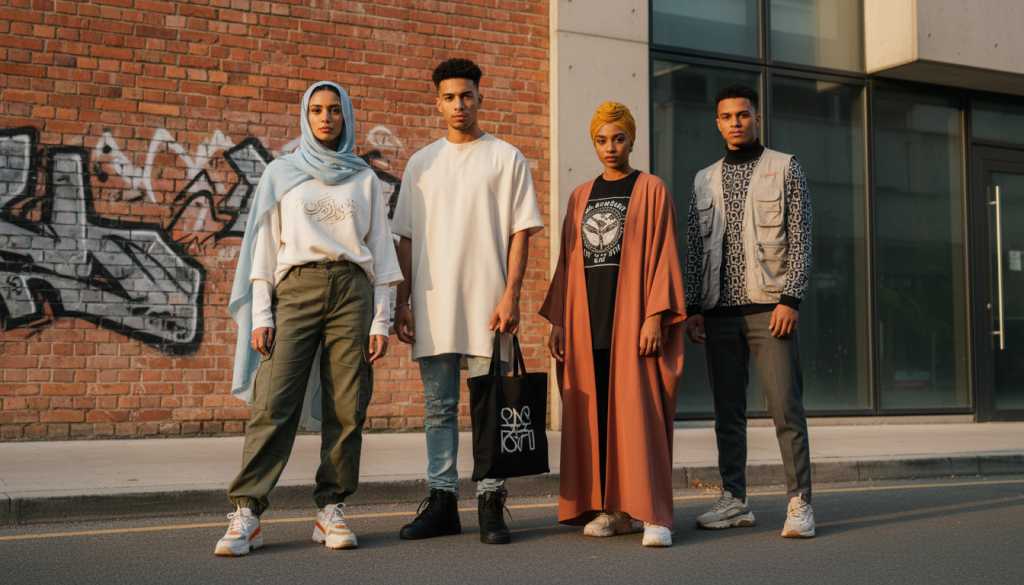
Ah, Islamic Streetwear, a fascinating oxymoron, isn’t it? One might imagine the term conjures images of devout individuals performing ablution on a skateboard, or perhaps a spirited game of hoops in a designer abaya. But no, dear reader, the reality is far more…commercially nuanced. We’ve witnessed the curious alchemy of modest fashion transforming into a multi-million-dollar industry, and now, it appears, the streets have beckoned. Because what better way to express one’s piety than with a limited-edition, logo-emblazoned hoodie that screams, “I’m spiritual, but also, I queued for this”?
The Sacred and the Swag: A Conundrum
Streetwear, in its purest, most romanticized form, emerged from the gritty, rebellious undercurrents of youth culture. It was about authenticity, exclusivity, and a certain defiant cool that couldn’t be bought – unless, of course, you knew the right connections or were willing to pay a ludicrous resale price. It spoke of skate parks, hip-hop beats, and a nonchalant swagger that was anything but polished. It was the antithesis of haute couture, a sartorial middle finger to the establishment.
Now, let’s pivot to traditional notions of modesty. Historically, this concept revolved around humility, understated elegance, and often, a deliberate withdrawal from ostentation. The idea was to dress in a manner that drew attention to one’s character, not one’s couture. It was about inner grace, not outer labels. A quiet dignity that whispered, rather than shouted, its presence.
So, how precisely do these two seemingly disparate worlds collide? How does the raw, rebellious spirit of the street reconcile with the serene, humble tenets of faith? With a hefty designer price tag, naturally. The common ground, it turns out, isn’t shared values or a revolutionary aesthetic, but rather the universal language of consumerism, translated through the ever-versatile medium of fabric.
The Branding of Belief: Logos and Liturgy
The rise of Islamic Streetwear has brought with it an intriguing array of brands, each vying for a slice of this increasingly lucrative pie. We see hoodies adorned with elegant Arabic calligraphy, T-shirts featuring stylized mosque motifs, and sneakers subtly (or not-so-subtly) incorporating traditional patterns. It’s a fascinating blend of the sacred and the utterly superficial, where a verse from the Quran might sit comfortably next to a brand’s ubiquitous logo, both proclaiming their presence with equal gravitas.
This isn’t just about wearing clothes; it’s about making a statement. A performative declaration that says, “I am a person of faith, but also incredibly fashion-forward.” It’s an intricate dance between devotion and declaration, where the act of dressing becomes a public sermon, albeit one delivered via expensive cotton blends. One wonders if the spiritual uplift is truly felt, or if it’s merely the thrill of being seen in the latest drop.
Authenticity for a Price: The Irony of Exclusivity
Streetwear thrives on exclusivity. Limited drops, scarcity, the frantic rush to acquire that coveted item before it sells out – these are the hallmarks of the genre. But how does this translate into a faith that preaches equality, community, and accessibility? Is piety now a commodity, available only to those quick enough with their credit card or deep enough in their pockets?
The target audience, it seems, is a demographic that is both young and affluent, eager to signal their unique blend of cultural identity and consumer power. They are the pioneers of a new aesthetic, where their faith is not just practiced, but also conspicuously consumed. It’s a testament to the ingenuity of marketers, who have managed to package spiritual aspiration into a trendy ensemble, proving that even the most profound concepts can be rendered into retail therapy.
Beyond the Hypebeast Hijab: What’s Underneath?
One can’t help but ponder the substance beneath the stylish veneer. Is this new wave of pious streetwear truly fostering a deeper connection to faith, inspiring introspection and spiritual growth? Or is it merely another layer of consumerism, cleverly disguised as cultural expression, where the ultimate goal is to belong to an exclusive club of the well-dressed devout?
The commodification of identity is a well-trodden path in the fashion world. From punk to preppy, every subculture eventually finds itself on a rack in a department store. Islamic Streetwear, in its current iteration, feels less like an organic grassroots movement and more like a carefully curated marketing strategy, inviting individuals to buy into a lifestyle rather than embody its more profound principles. It’s the ultimate irony: seeking humility through the most ostentatious means.
The Modest Fashion Paradox, Reloaded
This phenomenon is, in many ways, a reloaded version of the modest fashion paradox we’ve observed for years. The quest for modesty, ironically, often morphs into a spectacle, where the very act of covering becomes a means of drawing attention. Islamic Streetwear merely adds another layer to this intricate dance, blending religious identity with the hyper-consumerist tendencies of modern youth culture.
It’s a continuous evolution, where “modesty” as a concept is stretched, pulled, and reinterpreted to fit the prevailing trends, often shedding its original intent in the process. What began as a principle of humility and discretion now often finds itself adorned with bold graphics, exclusive branding, and a price tag that screams anything but understated.
Ultimately, the world of pious streetwear is a shimmering mirage of paradoxes. It’s a testament to our collective human desire to belong, to express, and perhaps, to subtly signal our affiliations – even if those affiliations come with a premium price tag and a healthy dose of irony. One can only hope that amidst the limited-edition drops and the pursuit of street cred, the actual spirit of modesty doesn’t get lost in the designer fabric softener.