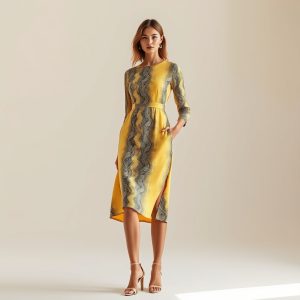
The Chromatic Revolution: How Creamy Yellow and Animal Prints Are Redefining the Poetics of Recreation Dressing

The fashion landscape is undergoing a seismic shift, one where the boundaries between utility and romance are not just blurred but entirely redrawn. At the heart of this transformation lies a chromatic and textual rebellion—creamy yellow and animal prints—two elements that, at first glance, seem disparate but together forge a new lexicon of recreation dressing. This is not merely a trend; it is a recalibration of aesthetic values, where the softness of butter yellow meets the untamed ferocity of snake and leopard motifs, creating a dialogue that is as much about identity as it is about style.
The Alchemy of Creamy Yellow
Creamy yellow, often dismissed as a mere neutral, is in fact a chromatic powerhouse. Its understated warmth evokes the golden hour of a summer’s evening, a hue that is both nostalgic and forward-looking. In the context of recreation dressing, it serves as a canvas, a soft backdrop that allows for experimentation without overwhelming the senses. Unlike its bolder counterparts—mustard or neon—creamy yellow is unassuming, yet its presence is transformative. It elevates the mundane, turning a simple utility dress into a statement of quiet luxury. This is the color of slow living, a visual manifestation of the desire to pause, to savor, to exist in a space where time moves at its own pace.
What makes creamy yellow particularly compelling is its versatility. It bridges the gap between the sporty and the poetic, the functional and the fantastical. A creamy yellow jumpsuit, for instance, can be paired with chunky sneakers for a mode sportif look or with delicate ballet flats for a touch of poet core elegance. It is this duality that makes it a cornerstone of modern recreation dressing—a movement that rejects the rigid binaries of fashion in favor of fluid, adaptable aesthetics.
The Untamed Allure of Animal Prints
If creamy yellow is the whisper, animal prints are the roar. Snake, leopard, and zebra motifs have long been associated with glamour, but their role in contemporary fashion extends far beyond mere ornamentation. These prints are subversive; they challenge the notion of what is considered “appropriate” or “refined.” In the realm of recreation dressing, animal prints serve as a reminder that fashion is not just about conformity but about expression—raw, unfiltered, and unapologetic.
The resurgence of animal prints in recent seasons is not coincidental. It reflects a broader cultural shift toward embracing the wild, the unpredictable, the untamed. In a world that often demands uniformity, animal prints are a form of rebellion, a way to assert individuality without uttering a word. When paired with creamy yellow, the effect is striking—a juxtaposition of softness and ferocity that feels both modern and timeless. A snake-print skirt with a creamy yellow blouse, for example, is not just an outfit; it is a manifesto, a declaration of intent.
The Intersection of Utility and Fantasy
Recreation dressing, as a concept, thrives at the intersection of utility and fantasy. It is about garments that are as functional as they are beautiful, designs that serve a purpose without sacrificing aesthetics. Creamy yellow and animal prints embody this ethos perfectly. The former offers a sense of ease and practicality, while the latter injects a dose of drama and intrigue. Together, they create a sartorial language that is as much about living as it is about looking.
Consider the utility dress—a staple of recreation dressing. Traditionally associated with functionality, it has been reimagined through the lens of creamy yellow and animal prints. A creamy yellow utility dress, for instance, retains its practical elements—pockets, adjustable straps, durable fabric—but its color elevates it to something more. Add a snake-print belt or leopard-print accessories, and the dress transcends its utilitarian roots, becoming a piece that is as suited to a café as it is to a gallery opening. This is the magic of recreation dressing: it takes the ordinary and makes it extraordinary.
The Role of Texture and Fabric
The success of this chromatic and textual revolution hinges not just on color and print but on the tactile experience of fabric. Romantic fabrics—silk, chiffon, lace—play a crucial role in softening the boldness of animal prints, while brut denim and structured cottons ground the ethereality of creamy yellow. The interplay of textures is what gives recreation dressing its depth, its richness. A creamy yellow silk blouse paired with a snake-print denim skirt, for example, creates a contrast that is both visually and physically engaging. The smoothness of the silk against the roughness of the denim, the fluidity of the blouse against the structure of the skirt—these are the details that make the look.
Moreover, the choice of fabric can dictate the mood of the outfit. A creamy yellow linen dress, for instance, exudes a sense of effortless elegance, perfect for a leisurely afternoon. In contrast, a creamy yellow satin slip dress paired with animal-print accessories takes on a more glamorous, evening-appropriate vibe. The versatility of these elements is what makes them so powerful—they can be dressed up or down, tailored to fit any occasion, any mood.
The Future of Recreation Dressing
As fashion continues to evolve, so too will the ways in which we interpret recreation dressing. The fusion of creamy yellow and animal prints is not a fleeting trend but a reflection of a broader cultural movement toward authenticity and self-expression. It is a rejection of the idea that fashion must be either practical or fantastical, sporty or romantic. Instead, it embraces the idea that these elements can coexist, that beauty lies in the tension between them.
The rise of recreation dressing also signals a shift in how we view clothing. No longer are garments mere tools for covering the body; they are extensions of our identities, vehicles for storytelling. Creamy yellow and animal prints, in their own ways, tell stories—of nostalgia, of rebellion, of the wild and the refined. They invite us to play, to experiment, to redefine what it means to dress for ourselves rather than for others. In a world that often feels chaotic and uncertain, this is a small but powerful act of defiance—a reminder that fashion, at its best, is not just about what we wear but about how we choose to live.
This chromatic revolution is far from over. If anything, it is just beginning. As designers continue to push boundaries and consumers embrace the freedom to mix, match, and reimagine, the possibilities are endless. The future of fashion lies not in rigid categories but in fluidity, in the spaces where creamy yellow meets snake print, where utility meets fantasy, where the ordinary becomes extraordinary. And in that space, we find not just clothing, but a new way of seeing the world.