The Sartorial Paradox: When Modesty Becomes a Spectacle
In the grand theatre of contemporary fashion, where every trend is meticulously dissected, re-packaged, and monetized, ‘modesty’ has unexpectedly taken center stage, not as a quiet whisper, but as a rather loud, performative declaration. Not the quiet, unassuming modesty of yesteryear, mind you, that often manifested as an unstyled, practical choice. No, this is a bold, almost defiant iteration – a ‘styled’ modesty that demands attention through its very insistence on discretion. We’re no longer just covering up; we’re curating our coverage, draping ourselves in layers of deliberate discretion that paradoxically often scream for recognition louder than a sequined mini-skirt at a silent retreat. We’ve moved beyond mere fabric; we’re now dealing in philosophical statements wrapped in chiffon and linen, often accompanied by a price tag that suggests not just ethical sourcing, but perhaps a direct consultation with the divine for design approval.
The Layering Labyrinth: More is, Apparently, Modest
Ah, layering. The cornerstone of the modern modest wardrobe. Once a practical solution to fluctuating temperatures or a clever way to extend a wardrobe, it has now ascended to an art form – a performance art, perhaps. We see women, often in climates that would make a desert lizard sweat, meticulously assembling outfits comprising a long-sleeved top, under a sleeveless dress, over wide-leg trousers, topped with a cardigan, and cinched with a belt. The sheer volume of fabric is enough to make a textile factory weep tears of joy, and one wonders about the practical burden of carrying such sartorial weight. Is it truly liberating, or merely a different form of fashionable constraint? One wonders if the ultimate goal is not genuine modesty, but rather to achieve a state of sartorial immobius, a human onion so intricately constructed that the simple act of reaching for a coffee cup becomes a choreographed ballet, and genuine movement a secondary concern to aesthetic accumulation.
Modest Activewear: The Sweaty Enigma
And then there’s the truly baffling phenomenon of “Modest Activewear.” Because, clearly, the primary concern when engaging in strenuous physical activity is ensuring one’s silhouette remains utterly undefined. Picture it: a woman, clad in a long-sleeved, high-necked, tunic-length top, paired with wide-leg, ankle-length pants, perhaps even a full-coverage hijab, attempting a vigorous CrossFit session. The irony, much like the wearer’s inevitable perspiration levels, is palpable. While the spirit of modesty in all aspects of life is commendable, one must question the practicalities of swaddling oneself in yards of moisture-wicking (or, let’s be brutally honest, often not-wicking, but aesthetically pleasing for the ‘gram) fabric while aiming for peak athletic performance. Is the goal to break a personal record on the treadmill, or merely to look like one might break a sweat without actually doing anything so un-chic as to disrupt the perfectly draped silhouette? The marketing campaigns often feature women gracefully stretching in pristine, uncreased fabrics, a vision far removed from the reality of a genuine workout.
The ‘Minimalist’ Modest Mirage
Simultaneously, we’re told to embrace “Minimalist Modest Fashion.” A paradox wrapped in an enigma, tied with a sustainable hemp bow. How does one achieve minimalism when the very essence of modest wear often involves more fabric, more layering, more presence? It often translates to neutral color palettes and simple silhouettes, yes, but often at eye-watering prices. It’s not about owning less; it’s about owning fewer, more expensive things that look like you own less – preferably in a muted, ‘earthy’ palette that screams ‘conscious consumer’ even if the garment itself required three transatlantic flights to assemble its ‘minimalist’ components. The ultimate humblebrag in textile form, where simplicity is a luxury, a carefully chosen aesthetic, rather than a default born of necessity or genuine disinterest in material excess.
Halal Hype and the ‘Contemporary’ Conundrum
The market, ever eager to capitalize on any demographic, has also blessed us with “Halal Fashion.” One can almost hear the angels singing as designers slap a “Halal” label on an otherwise perfectly normal garment. What precisely makes a dress ‘Halal Fashion’? Is it imbued with special properties during manufacturing? Does it come pre-blessed by an Imam with a discerning eye for prêt-à-porter? Does it miraculously repel interest-based transactions, ensuring your purchase is entirely virtuous? Or does it simply mean it adheres to a vague, often commercially malleable interpretation of Islamic dress codes, allowing savvy brands to tap into a lucrative niche while often offering little more than standard garments with slightly longer sleeves and a carefully worded marketing blurb that promises spiritual alignment with your wardrobe?
The ‘Contemporary’ Stretch: How Far Can We Go?
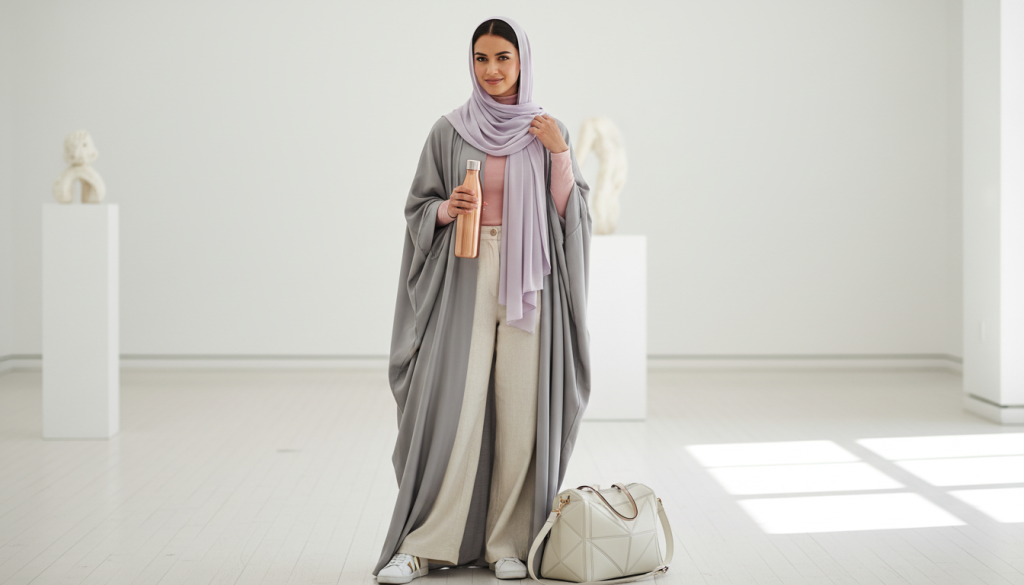
And finally, the ‘Contemporary Hijab’ or ‘Modern Kimono Abaya’. The relentless push to make traditional garments “relevant” and “fashion-forward.” While innovation is often good, one has to wonder at what point “contemporary” stretches the definition of “modest” to its breaking point. When an abaya morphs into a sheer, embellished kimono worn over a slip, or a hijab is styled into gravity-defying turbans that require industrial-strength hairspray, more pins than a pincushion convention, and a tutorial video that lasts longer than the average prayer, are we still adhering to the spirit of modesty, or simply performing a new, highly stylized kind of sartorial gymnastics for the ‘gram? It’s a delicate dance between tradition and trend, often resulting in a dizzying spectacle where the original intent gets lost in a flurry of fabric, filters, and frantic attempts to maintain structural integrity against the forces of gravity and social media scrutiny. The line between respectful adaptation and outright appropriation, or even parody, becomes increasingly blurred.
So, as we navigate this brave new world where discretion is designed and piety is prêt-à-porter, one might pause to consider the true meaning of modesty. Is it an external aesthetic, meticulously curated and endlessly photographed, or something far more internal and less susceptible to the whims of seasonal trends? Perhaps the most genuinely modest statement one can make is to simply be, without the elaborate performance, the endless layers, the carefully constructed image of what modesty should look like according to the latest style guide, or the frantic search for a ‘halal-certified’ scrunchie that promises both ethical production and perfect volume. After all, true elegance, much like true modesty, often whispers rather than shouts, manifests internally rather than externally, and most certainly doesn’t require a trending hashtag, a designer label, or a carefully curated Instagram feed to validate its existence. Sometimes, less truly is more, especially when it’s authentic.