The Geometry of Belonging: How Custom Fit Pattern Drafting and Zero-Waste Design Are Redrawing the Human Form
There is a quiet magic in the way a garment settles against the skin—not just as fabric, but as a second silhouette, a conversation between body and cloth. For centuries, fashion has been a dialogue between the measurable and the mysterious: the precise arc of a shoulder blade, the subtle asymmetry of a waist, the way a sleeve must curve to accommodate the bend of an elbow. Yet, for all its poetry, the act of dressing has often been a compromise, a negotiation between the idealized forms of mass production and the lived, breathing reality of individual bodies. What if, instead of forcing the body to conform, we allowed the garment to adapt? What if the seams themselves could listen?
The Alchemy of Anthropometric Design
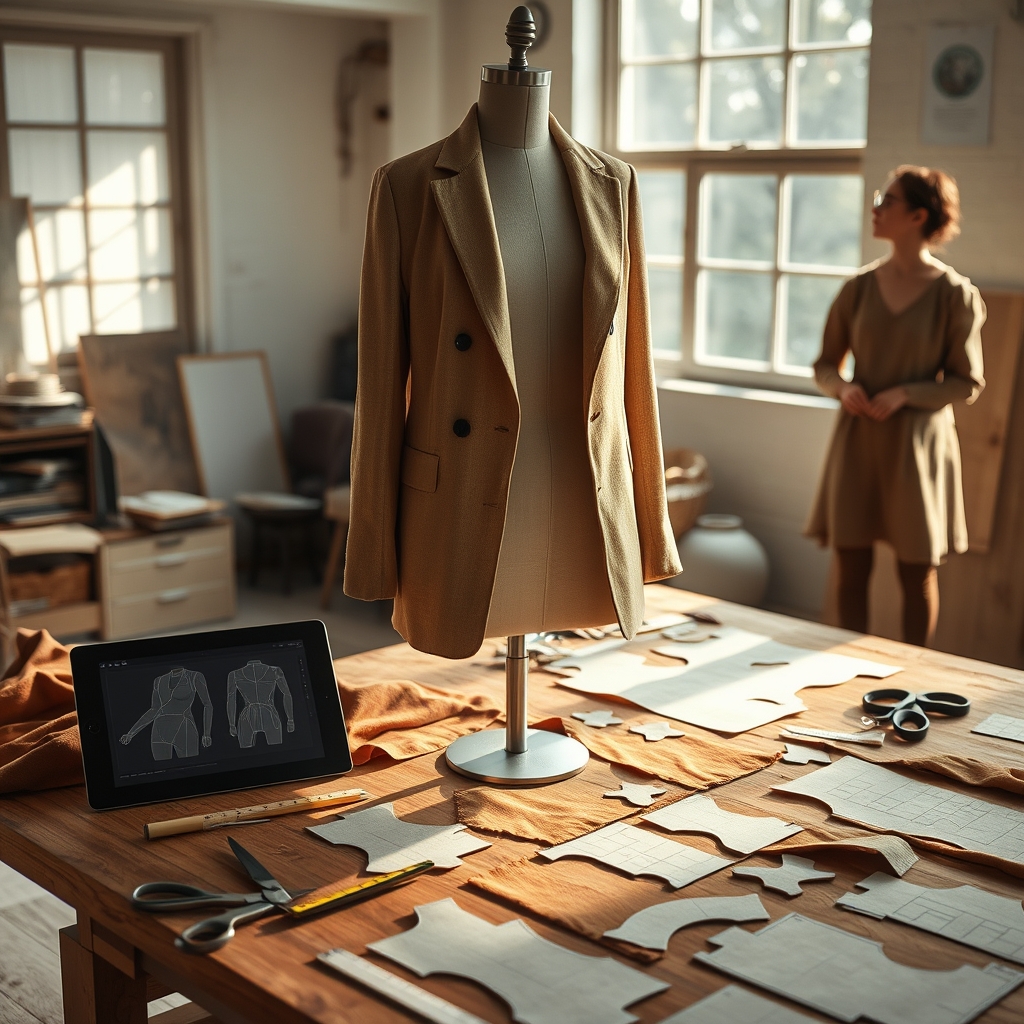
Anthropometric design optimization is not merely about measurements—it is about reverence. It is the science of honoring the body’s unique topography, where every contour is a story, every proportion a whisper of identity. Traditional pattern drafting, with its standardized sizing charts, has long treated these stories as outliers, squeezing diversity into rigid templates. But the rise of digital pattern development has begun to unravel this paradigm, replacing guesswork with precision, approximation with intimacy. Tools like 3D garment simulation now allow designers to drape fabric over virtual bodies that breathe, move, and exist in all their imperfect glory. The result is not just a better fit, but a deeper understanding of what fit truly means: not the absence of gaps, but the presence of harmony.
This shift is more than technical—it is philosophical. When a garment is engineered to mirror the body’s geometry, it ceases to be an imposition and becomes an extension. The wearer is no longer a passive recipient of design but an active participant in its creation. Collaborative fashion prototyping takes this further, inviting users into the drafting process, where their movements, preferences, and even emotions shape the final piece. It is a dance of co-creation, where the designer’s hand meets the wearer’s lived experience, and the pattern emerges as a shared language.
The Zero-Waste Paradox: When Less Becomes More
If custom fit pattern drafting is about listening to the body, zero-waste pattern cutting is about listening to the earth. The fashion industry has long treated fabric as an infinite resource, discarding scraps like afterthoughts, as if the land and labor that produced them were equally disposable. But what if waste were not an inevitability, but a failure of imagination? Zero-waste design challenges us to see fabric not as a flat plane to be carved into, but as a puzzle where every piece has purpose. The seams do not just hold the garment together—they hold the story of its making, a narrative of restraint and ingenuity.
This approach demands a radical rethinking of construction. Instead of starting with a sketch and forcing the fabric to comply, designers begin with the textile’s dimensions, letting its width and length dictate the form. The result is often unexpected: garments that fold into themselves, seams that double as decorative elements, patterns that interlock like the pieces of a living mosaic. It is a practice of humility, where the designer’s ego yields to the material’s inherent logic. And in this surrender, something beautiful emerges—not just a garment, but a testament to the possibility of abundance without excess.
The Digital Mirror: Virtual Try-On and the Illusion of Touch
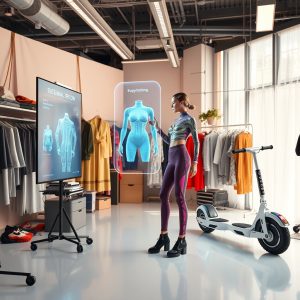
There is a moment, just before trying on a garment, when anticipation hums in the air. Will it fit? Will it move with me? Will it feel like mine? Virtual try-on technology seeks to capture that moment, to distill the alchemy of connection into pixels and code. Yet, for all its sophistication, it remains an approximation—a shadow of the tactile truth. A screen can simulate the drape of fabric, the fall of a hem, but it cannot replicate the weight of a sleeve settling on your wrist, the whisper of linen against your collarbone. This is the paradox of digital fashion: it brings us closer to the body’s geometry while keeping us at a remove from its flesh.
And yet, there is power in this distance. Virtual try-on democratizes the bespoke experience, allowing users to explore fit and style without the constraints of physical inventory. It is a tool of exploration, a sandbox for self-expression, where the boundaries of identity can be tested and redefined. For those whose bodies have been marginalized by traditional sizing, this technology offers something rare: the chance to be seen. But it also raises questions about the nature of authenticity. If a garment exists only as data, does it still hold meaning? Or is meaning itself evolving, becoming something more fluid, more adaptable?
The Modular Future: Clothing as a Living System
What if a garment were not a static object, but a living system—one that grows, adapts, and transforms alongside its wearer? Modular clothing systems propose just that, reimagining apparel as a series of interchangeable components that can be reconfigured to suit changing needs, moods, or environments. A jacket becomes a vest, a dress becomes a top, a sleeve detaches to become a scarf. This is fashion as Lego, where the act of dressing is not just about covering the body, but about building it anew each day.
The implications are profound. Modularity challenges the very notion of ownership, inviting us to see clothing not as a possession, but as a relationship. It also offers a path to sustainability, reducing the need for excess by allowing a single garment to serve multiple purposes. But perhaps its greatest gift is the way it reframes our relationship with time. In a world where trends move at the speed of algorithms, modular clothing asks us to slow down, to engage with our wardrobes as evolving entities rather than disposable commodities. It is a reminder that fashion, at its core, is not about consumption, but about connection.
The Human Thread
At the heart of all these innovations—custom fit drafting, zero-waste design, virtual try-on, modular systems—lies a single, unshakable truth: clothing is not just about covering the body, but about revealing the self. The most revolutionary technologies are not those that distance us from the tactile, but those that bring us closer to the human. A garment that fits perfectly is not just well-made; it is a mirror, reflecting back the contours of our identity. A zero-waste pattern is not just efficient; it is a love letter to the earth. A modular system is not just practical; it is a celebration of adaptability, a recognition that we are not fixed, but ever-changing.
Perhaps, then, the future of fashion is not about replacing the old with the new, but about rediscovering what has always been true: that the most meaningful designs are not those that impose, but those that listen. That the most sustainable practices are not those that extract, but those that give back. And that the most beautiful garments are not those that follow the rules, but those that dare to rewrite them, stitch by stitch, seam by seam, in the quiet geometry of belonging.