
The Symphony of Skin: How Interactive Clothing Design and Anthropometric Precision Are Composing the Future of Fit
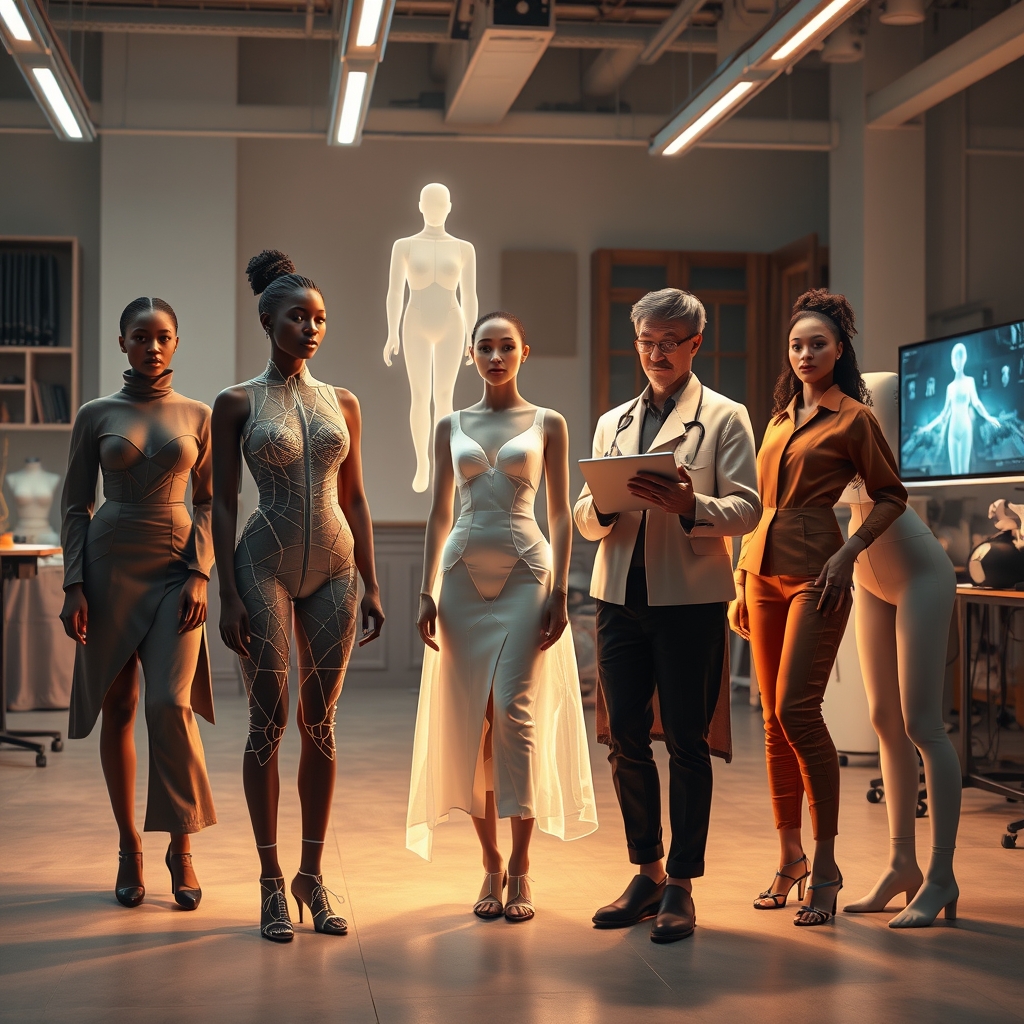
The first time I slipped into a garment that had been woven not just from fabric, but from data, I felt the quiet hum of something revolutionary. It wasn’t merely the way the seams curved around my shoulders with an almost sentient awareness, or how the hem settled against my ankles like a whispered promise. It was the realization that clothing, in its most evolved form, is no longer a static object draped over the body—it is a dialogue. A conversation between flesh and thread, between measurement and movement, between the silent language of the body and the coded poetry of design. This is the era of interactive clothing design, where the once-rigid boundaries of pattern drafting dissolve into something fluid, responsive, and deeply, almost sacredly, personal.
The Body as a Living Canvas
For centuries, fashion has treated the human form as a fixed entity—an idealized silhouette to which fabric must conform, often at the cost of comfort, individuality, or even dignity. The standard sizing charts that dominate ready-to-wear production are, at best, a blunt instrument, a one-size-fits-most approximation that fails to account for the infinite variations of human anatomy. But what if the body were not a constraint, but a collaborator? What if every curve, every asymmetry, every subtle shift in posture were not obstacles to be overcome, but notes in a symphony waiting to be composed?
Anthropometric design optimization is the bridge between the abstract and the intimate. By harnessing 3D body scanning, motion capture, and biomechanical analysis, designers can now draft patterns that are not just tailored, but alive. These are garments that breathe with the wearer, that stretch and contract in harmony with movement, that remember the body’s preferences like a lover’s touch. The result is not just a better fit, but a redefinition of what fit even means—no longer a static state, but a dynamic relationship.
The Alchemy of Zero-Waste and the Poetry of Precision
Yet even as technology allows us to honor the body’s uniqueness, it also invites us to reconsider our relationship with the earth. Zero-waste pattern cutting is not merely a technique; it is a philosophy, a meditation on the sacredness of resources. In a world where the fashion industry accounts for nearly 10% of global carbon emissions, the act of drafting a pattern that leaves no scrap behind is an act of resistance. It is a refusal to participate in the cycle of excess, a declaration that beauty need not come at the cost of waste.
When combined with digital pattern development, zero-waste design becomes a form of alchemy. Software like CLO 3D or Optitex allows designers to simulate fabric behavior, drape, and fit before a single cut is made. The result is a garment that is not just efficient, but elegant—a seamless fusion of form and function, where every seam, dart, and fold serves a purpose. This is precision as poetry, where the cold logic of algorithms meets the warm intuition of the human hand.
The Mirror That Listens: Virtual Try-On and the Democratization of Fit
There is a moment in every fitting room when the mirror becomes a judge, a critic, a sometimes cruel arbiter of self-worth. The harsh lighting, the unflattering angles, the way a garment clings in all the wrong places—it is a ritual that has left countless people feeling alienated from their own bodies. But what if the mirror could listen? What if it could adapt, suggest, even understand?
Virtual try-on technology is transforming the fitting room from a place of judgment into a space of collaboration. Using augmented reality and AI-driven fit analysis, these systems allow users to see how a garment will look and move on their body, in real time, without ever stepping into a physical store. The implications are profound. For those with disabilities, adaptive clothing solutions can be tested and refined without the frustration of trial and error. For plus-size or petite individuals, who have long been underserved by standard sizing, it offers a path to garments that fit not just their bodies, but their identities. And for the industry as a whole, it is a step toward a more inclusive, more empathetic future—one where fit is not a privilege, but a right.
The Human Touch in a Digital Age
Yet for all its wonders, technology alone cannot capture the soul of a garment. There is a reason why, even in the age of 3D garment simulation, the most revered tailors still rely on the pinch of fabric between their fingers, the way a seam falls when held to the light. The best interactive clothing design is not about replacing the human touch, but augmenting it—giving designers the tools to iterate faster, to experiment bolder, to fail more gracefully. It is about freeing them from the tedious constraints of manual pattern drafting so they can focus on what truly matters: the feeling of a garment, the way it moves with the body, the story it tells.
Collaborative fashion prototyping takes this a step further, turning design into a conversation. Imagine a platform where designers, pattern makers, and even wearers can co-create a garment in real time, tweaking proportions, adjusting details, and refining fit until it feels like a second skin. This is not just user-centric apparel development; it is a democratization of creativity, where the line between designer and wearer blurs into something more fluid, more democratic.
The Future Worn on the Skin
Perhaps the most profound shift brought about by these innovations is the way they reframe our relationship with clothing. No longer are garments passive objects, mere coverings for the body. They are becoming extensions of ourselves—adaptive, responsive, almost sentient. A dress that adjusts its opacity based on sunlight, a jacket that heats up in response to cold, a pair of pants that stretches with every stride: these are not just products, but experiences. They are the first whispers of a future where clothing is not just worn, but lived.
Yet even as we marvel at the possibilities, it is worth remembering that the most revolutionary aspect of this shift is not the technology itself, but the way it invites us to reconnect with our bodies. In a world that often treats the body as a problem to be solved—a thing to be sculpted, altered, or hidden—interactive clothing design offers a different narrative. It says: Your body is not a flaw to be corrected. It is a masterpiece to be celebrated. And perhaps, in that celebration, we will find not just better-fitting clothes, but a deeper, more compassionate relationship with ourselves.
The garments of the future will not just fit our bodies; they will fit our lives. They will move with us, adapt to us, grow with us. And in doing so, they will remind us that the most perfect fit is not the one that conforms to an ideal, but the one that honors the truth of who we are—flaws, asymmetries, and all. This is the quiet revolution of skin and thread, where every stitch is a love letter to the body, and every seam is a promise: You are seen. You are enough.