The New Rhythm of Fashion: How Recreation Dressing and Moccasins Are Orchestrating the Slow Living Jazz Age Revival

The Jazz Age was never just about the music—it was a cultural symphony of movement, rebellion, and effortless elegance. Nearly a century later, its echoes are reverberating through contemporary fashion, not as a mere revival, but as a reimagining. At the heart of this resurgence lies the interplay between Recreation Dressing and moccasins, two seemingly disparate elements that, when fused, craft a new lexicon of slow living. This is not nostalgia for nostalgia’s sake; it is a deliberate recalibration of style’s tempo, where utility meets poetry, and movement is measured in deliberate, unhurried steps.
The Jazz Age Revisited: A Blueprint for Modern Leisure
The 1920s were defined by a paradox: the frenetic energy of speakeasies and Charleston dances coexisted with an undercurrent of refined minimalism. The era’s fashion mirrored this duality—drop-waist dresses that swayed with the body’s rhythm, yet structured in a way that suggested restraint. Today, Recreation Dressing channels this spirit, not by replicating flapper silhouettes, but by embracing their ethos: clothing designed for movement, yet imbued with an air of nonchalance. The modern iteration trades fringe for fluidity, replacing sequins with breathable linens and relaxed tailoring. It is leisurewear elevated to an art form, where the act of dressing becomes an extension of the body’s natural cadence.
Enter the moccasin, a footwear staple that predates the Jazz Age but found its perfect partner in the era’s laid-back sophistication. Unlike the rigid Oxfords or towering heels of the time, moccasins offered a quiet rebellion—a shoe that whispered rather than shouted. Today, they serve as the anchor of Recreation Dressing, their supple leather and minimalist design embodying the slow living movement’s core tenets: comfort without compromise, elegance without effort. When paired with wide-leg trousers or a bias-cut dress, they transform an outfit from mere attire to a statement of intentionality.
The Slow Living Manifesto: Utility Meets Poetry
Slow living is often misconstrued as a retreat from modernity, a romanticized return to a simpler time. In reality, it is a radical act of resistance against the relentless pace of contemporary life. Fashion, as a visceral expression of culture, has become a battleground for this resistance. Recreation Dressing is its uniform: garments that prioritize function without sacrificing form, materials that age gracefully, and silhouettes that adapt to the wearer’s rhythm. It is the antithesis of fast fashion’s disposable ethos, a sartorial philosophy that values longevity over trends.
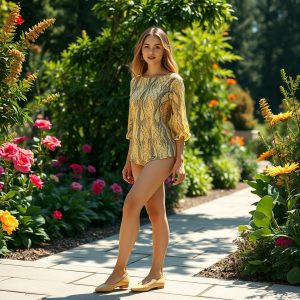
The moccasin, in this context, is more than a shoe—it is a metaphor. Its construction, rooted in indigenous craftsmanship, speaks to a reverence for tradition and time-honored techniques. The absence of a heel forces the wearer to move differently, to slow down, to engage with the ground beneath them. When paired with Recreation Dressing’s relaxed tailoring, the effect is transformative. A creamy yellow linen shirt, untucked and slightly oversized, drapes effortlessly over the body, its hue evoking the warmth of golden-hour light. Layered with a brut denim vest, the ensemble strikes a balance between ruggedness and refinement, a nod to the Jazz Age’s love of juxtaposition.
The Chromatics of Leisure: Creamy Yellow and the Art of Subtle Luxury
Color, in the Jazz Age, was a tool of subversion. The era’s palette—think Art Deco’s bold geometrics or the soft pastels of silent film stars—was a visual rebellion against the muted tones of the Victorian era. Today, creamy yellow has emerged as the unexpected heir to this legacy. Not the saccharine sweetness of buttercup, nor the stark brightness of lemon, but a muted, sun-bleached hue that feels both timeless and modern. It is the color of slow mornings and lingering afternoons, a visual manifestation of the slow living ethos.
When applied to Recreation Dressing, creamy yellow becomes a unifying force. A pair of wide-leg trousers in this shade, paired with a crisp white shirt and moccasins, channels the effortless elegance of a 1920s socialite lounging on a Riviera terrace. The color’s warmth softens the utilitarian edge of brut denim or the structured lines of a utility jacket, creating an ensemble that is at once relaxed and refined. It is a palette that refuses to shout, instead inviting the wearer—and the observer—to lean in, to appreciate the quiet luxury of well-made clothing.
The Moccasin’s Evolution: From Functional to Philosophical
The moccasin’s journey from practical footwear to a symbol of sartorial philosophy is a testament to fashion’s ability to imbue objects with meaning. Originally designed by Indigenous peoples of North America for their durability and comfort, moccasins were later adopted by European settlers and, eventually, by the leisure class of the early 20th century. Their association with the Jazz Age was no accident: the shoe’s flexibility mirrored the era’s embrace of movement and freedom, while its simplicity aligned with the period’s growing disdain for ostentation.
Today, the moccasin has been reclaimed by the slow living movement, not as a relic of the past, but as a tool for the present. Designers have reimagined the classic silhouette in unexpected ways—luxury iterations in buttery soft leather, or hybrid styles that blend the moccasin’s comfort with the structure of a loafer. The result is a shoe that transcends its functional roots, becoming a statement piece that speaks to the wearer’s values. When styled with Recreation Dressing, the moccasin completes a narrative of intentionality, where every element of an outfit is chosen with purpose, from the fabric’s weave to the way it moves with the body.
The Future of Leisure: A Jazz Age for the Modern Era
The resurgence of Recreation Dressing and moccasins is not a fleeting trend, but a harbinger of fashion’s future. As the boundaries between work and leisure continue to blur, the demand for clothing that adapts to both has never been greater. The Jazz Age’s influence lies not in its aesthetics, but in its ethos—a celebration of movement, individuality, and the joy of living unhurriedly. Recreation Dressing and moccasins embody this spirit, offering a blueprint for a wardrobe that is as adaptable as it is elegant.
The modern revival of these elements is a reminder that fashion, at its best, is not about dictating how to dress, but about providing the tools to craft a personal narrative. The moccasin’s soft sole encourages a slower pace, while Recreation Dressing’s relaxed silhouettes invite freedom of movement. Together, they form a sartorial language that speaks to the desire for a life less rushed, a world where style is not measured in trends, but in the quiet confidence of knowing exactly who you are. The Jazz Age may be long gone, but its rhythm lives on, not as a relic, but as a living, breathing part of the present.