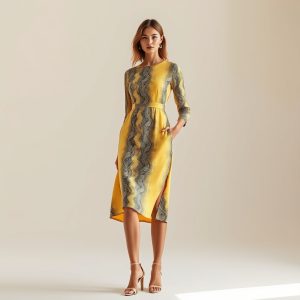
The New Syntax of Style: How ‘Going For Gold’ and Prints Galore Are Decoding the Language of Retro Summer

The fashion landscape is no longer a static canvas but a dynamic syntax, where each season rewrites its own grammar. The current lexicon is dominated by a collision of opposites—luxury and utility, nostalgia and innovation, restraint and excess. At the heart of this dialogue lies the resurgence of Retro Summer, a movement that transcends mere revivalism to become a coded language of modern identity. It is not about replication but reinterpretation, where the past is not copied but translated into a contemporary dialect.
The Alchemy of Gold: A Hue Beyond Gilded Excess
The phrase Going For Gold has evolved from a metaphor for ambition into a literal design ethos. Gold, in its myriad forms—gilded embroidery, metallic-threaded knits, or even the subtle sheen of a butter-yellow silk—has become the silent punctuation in fashion’s new sentence. It is no longer confined to the ostentatious; instead, it operates as a quiet assertion of value, a nod to craftsmanship in an era of mass production. The modern gold is not about opulence for opulence’s sake but about the alchemy of transforming the ordinary into the extraordinary. A gold-threaded utility dress, for instance, does not scream for attention; it whispers, demanding a second glance to uncover its duality—practicality wrapped in quiet luxury.
The Print Paradox: From Animal Instincts to Structured Chaos
If gold is the punctuation, then Prints Galore is the vocabulary. The current obsession with prints—particularly animal motifs—is not a fleeting trend but a structural shift in how we perceive pattern and narrative in clothing. Snake print, leopard spots, and zebra stripes are no longer relegated to the realm of the exotic or the provocative. Instead, they have been absorbed into the mainstream as a form of visual shorthand, a way to convey complexity without uttering a word. The paradox lies in their duality: they are both wild and domesticated, chaotic and controlled. A snake-print midi dress paired with a structured blazer, for instance, becomes a study in contrasts—ferocity tamed by tailoring, instinct balanced by intellect.
The Retro Summer Manifesto: Nostalgia as a Design Tool
Retro Summer is not a monolith but a spectrum, spanning the jazz-infused silhouettes of the 1920s to the sun-drenched minimalism of the 1990s. What unites these disparate eras is their shared ethos of recreation dressing—clothing designed not for spectacle but for lived experience. The modern iteration of this philosophy is less about literal recreation (think: picnic-ready gingham or beach-ready linen) and more about the spirit of leisure as a form of resistance. In a world obsessed with productivity, Retro Summer offers a counter-narrative: the idea that dressing well is not about performance but presence. A creamy-yellow sundress, for example, is not just a garment but a statement—an assertion that beauty can be found in stillness, that elegance is not synonymous with effort.
The Utility of Romance: When Function Meets Fantasy
The most compelling aspect of Retro Summer is its ability to merge utility dressing with romanticism. This is not the utilitarianism of the industrial age but a softer, more fluid interpretation—one where functionality is not at odds with femininity or fantasy. Consider the resurgence of the ballet flat, a shoe that embodies this duality. It is practical enough for urban commutes yet undeniably romantic, evoking the grace of a bygone era. Similarly, brut denim—raw, unwashed, unapologetically rugged—finds its counterpart in delicate lace trims or ruffled hems, creating a tension that is both visually striking and conceptually rich. This marriage of opposites is not a contradiction but a conversation, one that reflects the complexities of modern life.
The Slow Living Imperative: Why Retro Summer Endures
The longevity of Retro Summer lies in its alignment with the principles of slow living. In an era of fast fashion and fleeting trends, this aesthetic offers a counterpoint—an invitation to savor, to curate, to invest in pieces that tell a story. The resurgence of romantic fabrics—silk, chiffon, brocade—is not a rejection of modernity but a reclamation of time. These materials demand attention, not just in their creation but in their care. A butter-yellow blouse, for instance, is not a disposable item but a heirloom in the making, a piece that gains character with each wear. This is fashion as a form of mindfulness, where every stitch and seam is a reminder to slow down, to appreciate the craftsmanship behind the clothes we wear.
The syntax of modern style is not written in stone but in fluid, evolving strokes. Going For Gold and Prints Galore are not just trends but tools, allowing us to decode the language of Retro Summer and adapt it to our own narratives. This is not about dressing for an era but about dressing for the self—an act of curation that is as much about identity as it is about aesthetics. The clothes we choose become the words we use to articulate who we are, and in this new lexicon, every detail matters. The gold thread, the snake print, the creamy yellow—these are not just embellishments but the building blocks of a personal manifesto, a way to say something without speaking at all.