
The Luminous Skeleton: How Digital Pattern Development and Anthropometric Design Are Illuminating the Body’s Hidden Architecture
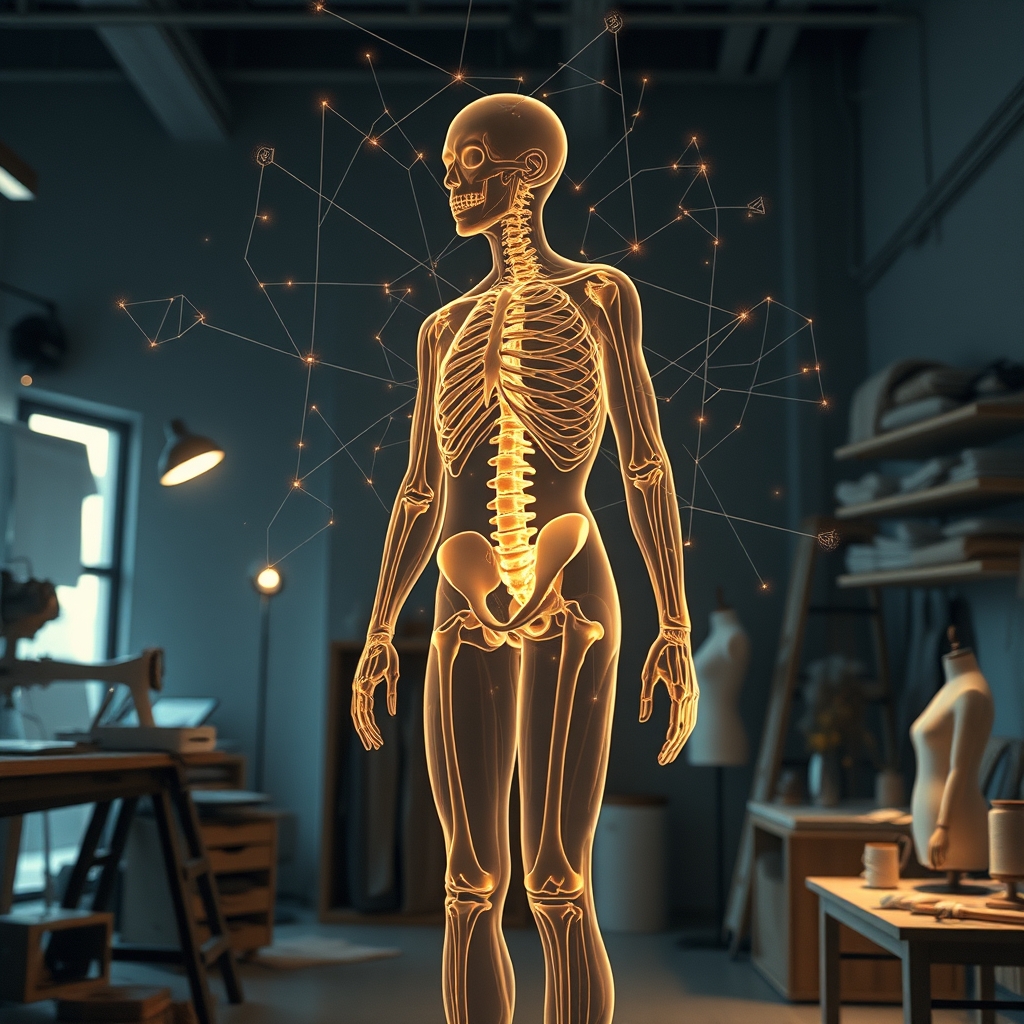
There is a quiet magic in the way a garment comes to life—not just in the stitches that bind it, but in the invisible architecture that precedes them. The body, after all, is not a flat plane but a living sculpture, a topography of curves and hollows, of muscle and breath. To drape fabric over it is to engage in a dialogue, one that has, for centuries, relied on intuition as much as it has on measurement. But what happens when that dialogue is no longer whispered in the dim light of a tailor’s studio, but illuminated by the cold precision of data? What emerges when the body’s hidden skeleton is not just felt, but seen?
The Body as Blueprint
The first time I watched a 3D scanner map the contours of a human form, I was struck by how vulnerable it felt—like witnessing an X-ray of the soul. The machine did not judge, did not flinch at the asymmetry of shoulders or the slight rotation of a hip. It simply recorded, translating flesh into coordinates, breath into geometry. This, I realized, was the future of fit: not an approximation, but a revelation. Anthropometric design does not merely measure the body; it deciphers it, uncovering the silent language of posture and proportion that has always existed beneath the skin.
Custom fit pattern drafting, once the domain of master tailors who relied on pins and experience, is now being reimagined through digital tools that can simulate the drape of fabric before a single cut is made. The result is not just efficiency, but a kind of intimacy—a garment that knows the body’s secrets before the wearer does. There is something almost sacred in this process, as if the act of creation has been elevated from craft to communion.
The Alchemy of Zero-Waste
Yet precision alone is not enough. The body is not a static object, and neither should the garments that clothe it be. Zero-waste pattern cutting is where this philosophy finds its purest expression. It is a rebellion against the wastefulness of an industry that has long treated fabric as disposable, a challenge to the notion that excess is inevitable. To design without waste is to engage in a kind of alchemy, transforming flat yards of cloth into something that moves with the body, that breathes with it, that leaves no trace behind.
I remember the first time I held a zero-waste pattern in my hands. The pieces fit together like a puzzle, each curve and angle serving a purpose, each seam a deliberate choice. There was no leftover, no scrap destined for the bin. It was as if the fabric itself had been given a voice, and it was singing a song of harmony. This is the future of sustainable garment construction—not as an afterthought, but as the very foundation of design.
The Virtual Fitting Room
But what of the wearer? How do we bridge the gap between the digital and the tactile, between the data-driven precision of anthropometric design and the lived experience of the body? Virtual try-on technology is where this bridge begins to take shape. No longer must we rely on the imperfect mirror of a fitting room, where lighting is unkind and movement is restricted. Instead, we step into a space where the garment exists in potential, where we can twist and turn, bend and stretch, and see how the fabric responds to our every motion.
There is a thrill in this, a sense of discovery. The first time I saw my own reflection in a virtual garment, I was struck by how alive it felt—how the fabric seemed to anticipate my movements, to flow with me rather than against me. It was as if the garment had been waiting for me all along, its form shaped not just by my measurements, but by the way I inhabit my body. This is the promise of user-centric apparel development: clothing that does not just fit, but understands.
The Collaborative Tapestry
Yet the most profound shift may not be in the technology itself, but in how we wield it. Collaborative fashion prototyping is breaking down the walls between designer and wearer, turning the act of creation into a shared journey. No longer is the designer the sole architect of the garment; instead, the wearer becomes a co-creator, their feedback woven into the very fabric of the design. This is not just customization, but collaboration—a meeting of minds and bodies, where the final product is as much a reflection of the wearer’s identity as it is of the designer’s vision.
I have seen this in action, in workshops where strangers gather to draft patterns together, where the act of measuring becomes an act of trust. There is a vulnerability in standing before another person, allowing them to trace the lines of your body, to see the places where you carry tension, where you hold yourself back. But there is also a profound connection, a sense of being seen—not just as a consumer, but as a participant in the creation of something meaningful.
The Unseen Threads
Perhaps this is the true revolution of modern garment construction: not the tools we use, but the relationships they foster. Digital pattern development and anthropometric design are not just about precision or efficiency; they are about redefining what it means to clothe the body. They are about recognizing that every stitch is a conversation, every seam a negotiation between fabric and flesh, between the seen and the unseen.
The body is not a problem to be solved, but a landscape to be explored. And as we stand at the intersection of technology and tradition, of data and intuition, we are learning to listen—to the quiet hum of the body’s hidden architecture, to the whisper of fabric as it settles into place, to the unspoken dialogue between what we wear and who we are. The garments of the future will not just fit the body; they will honor it, in all its imperfect, breathing, luminous complexity.