The Unfolding Body: How Anthropometric Design and Collaborative Prototyping Are Stitching the Future of Belonging
The body has always been a landscape of stories—curves that hold memories, folds that whisper of movement, and contours that map the quiet evolution of self. Yet, for so long, fashion has treated this terrain as something to be tamed, standardized, or ignored. The rigid grids of mass-produced patterns, the arbitrary sizing charts that slice humanity into fragments, the wasteful cuts that discard fabric like forgotten thoughts—all of it has felt like a conversation where the body’s voice was drowned out by the noise of industry. But what if the act of dressing could become a dialogue again? What if every stitch, every seam, every fold was an invitation to listen—not just to the body, but to the earth, to the hands that craft, to the future we’re weaving together?
The Body as a Living Blueprint
Anthropometric design is not merely about measurements; it is about reverence. It is the practice of seeing the body not as a static shape to be draped, but as a breathing, shifting entity—a living archive of posture, gesture, and presence. The old way of pattern drafting treated the body like a mannequin, a hollow vessel to be filled with fabric. But the new way? It treats the body like a collaborator. Digital tools now allow us to scan, map, and simulate the body in motion, capturing the way a shoulder rolls when reaching, the way a spine curves when sitting, the way a wrist bends when holding. These are not just data points; they are the poetry of human existence, translated into lines and curves that can finally fit without forcing.
This shift is more than technical—it is philosophical. When we design with the body’s true dimensions, we are no longer imposing an ideal; we are honoring a reality. The result is clothing that moves with the wearer, not against them. A dress that flows where it should, a jacket that hugs without constricting, a pair of pants that bends with the knee instead of fighting it. This is the quiet revolution of fit: not just better tailoring, but a deeper understanding of what it means to belong in one’s own skin.
The Alchemy of Zero-Waste: Where Every Scrap Tells a Story
If anthropometric design is about listening to the body, zero-waste pattern cutting is about listening to the earth. The fashion industry has long treated fabric like a disposable commodity, slicing and discarding with reckless abundance. But what if every piece of cloth was seen as a finite resource, a fragment of a larger story? Zero-waste design is not just a technique; it is a meditation on scarcity and abundance, on the value of what we often overlook.
Imagine a pattern laid out like a puzzle, where every edge, every corner, every irregularity is accounted for. There are no leftover scraps, no offcuts destined for the landfill. Instead, each piece interlocks with the next, creating a garment that is as efficient as it is beautiful. This is not just about sustainability—it is about creativity under constraint. When designers are forced to work within the boundaries of a single piece of fabric, they are pushed to innovate, to rethink, to see potential where others see limitation. The result is clothing that carries the mark of intention, where every seam feels deliberate, every fold feels like a discovery.
But zero-waste is not just a solitary act of design; it is a collaborative one. It requires pattern makers, fabric suppliers, and even wearers to rethink their relationship with material. It asks us to slow down, to consider the journey of the cloth before it reaches our hands, to see the hands that wove it, the earth that grew it, the future it might still hold. In this way, zero-waste is not just a method—it is a mindset, a way of seeing the world as interconnected, where nothing is truly wasted, only waiting to be transformed.
The Digital Handshake: When Technology Meets Craft
For all its precision, digital pattern development can sometimes feel cold, clinical—a world of pixels and algorithms where the human touch is lost. But what if technology was not the antithesis of craft, but its partner? What if digital tools could amplify the intuition of the maker, rather than replace it?
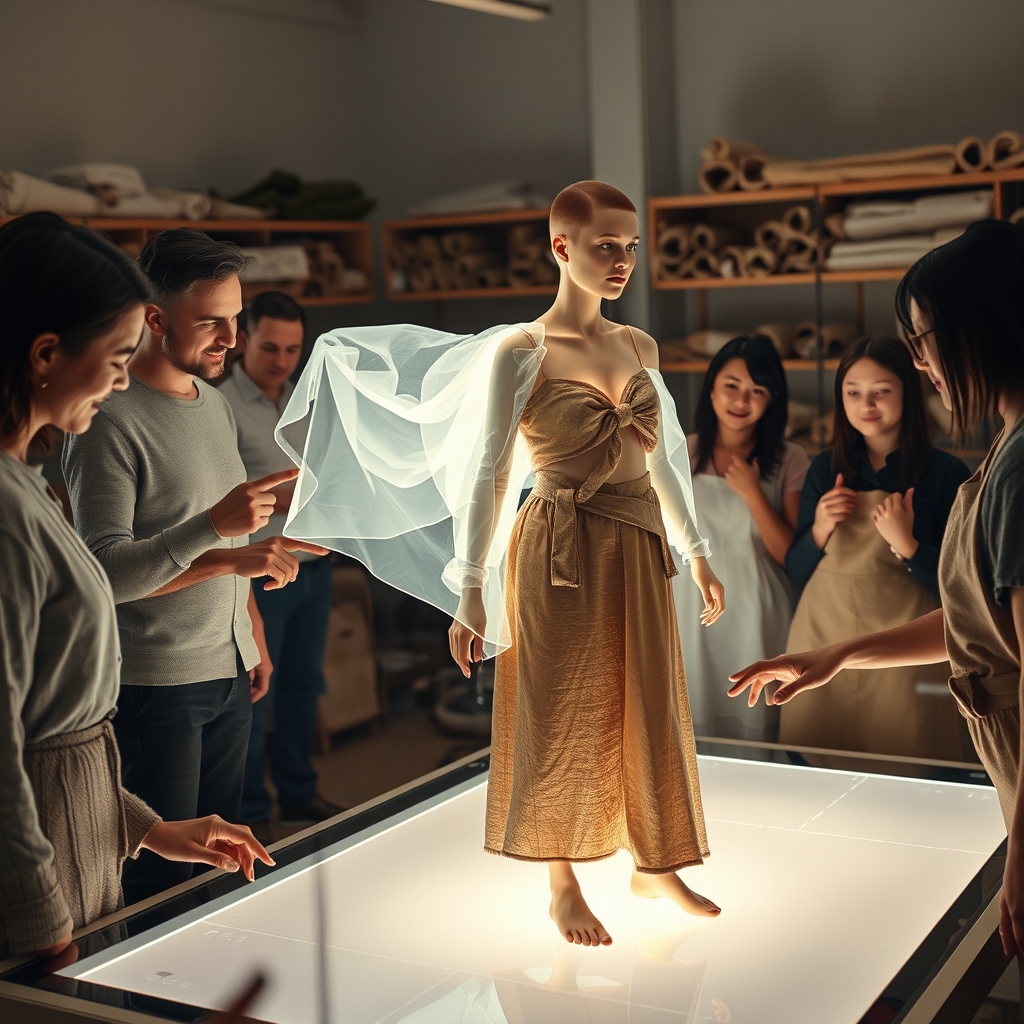
Collaborative fashion prototyping is where this alchemy happens. Imagine a designer in one city, a pattern maker in another, and a wearer in a third, all working together in real time on a shared digital platform. The designer sketches a concept, the pattern maker translates it into a 3D simulation, and the wearer virtually tries it on, offering feedback on fit, movement, and comfort. This is not just efficiency; it is empathy in action. It is the recognition that clothing is not just about aesthetics, but about experience—how it feels to wear, how it moves with you, how it becomes an extension of self.
3D garment simulation takes this a step further, allowing designers to see how fabric will drape, stretch, and flow before a single stitch is sewn. It is like having a crystal ball for fashion, a way to test, iterate, and refine without the waste of physical samples. But more than that, it is a bridge between the digital and the tactile, a way to preserve the soul of craftsmanship in an increasingly virtual world. The best digital tools do not replace the human hand; they extend it, allowing makers to experiment, to fail, to learn, and to create with a freedom that was once unimaginable.
The Future is a Shared Stitch
Perhaps the most radical idea in this new era of fashion is that clothing is not something we consume, but something we co-create. When we embrace anthropometric design, zero-waste cutting, and collaborative prototyping, we are not just making better garments—we are making a better relationship with the world. We are saying that the body is not a problem to be solved, but a story to be honored. That fabric is not a resource to be exploited, but a gift to be cherished. That technology is not a replacement for human connection, but a tool to deepen it.
This is not just the future of fashion; it is the future of how we see ourselves. When we dress in clothing that fits us perfectly, that moves with us effortlessly, that carries the mark of intention and care, we are not just wearing fabric—we are wearing a philosophy. A philosophy that says: I belong here. Not just in this garment, but in this world. And so do you.