
The Hushed Algebra of Fit: How Zero-Waste Pattern Cutting and Anthropometric Whispers Are Decoding the Body’s Secret Language
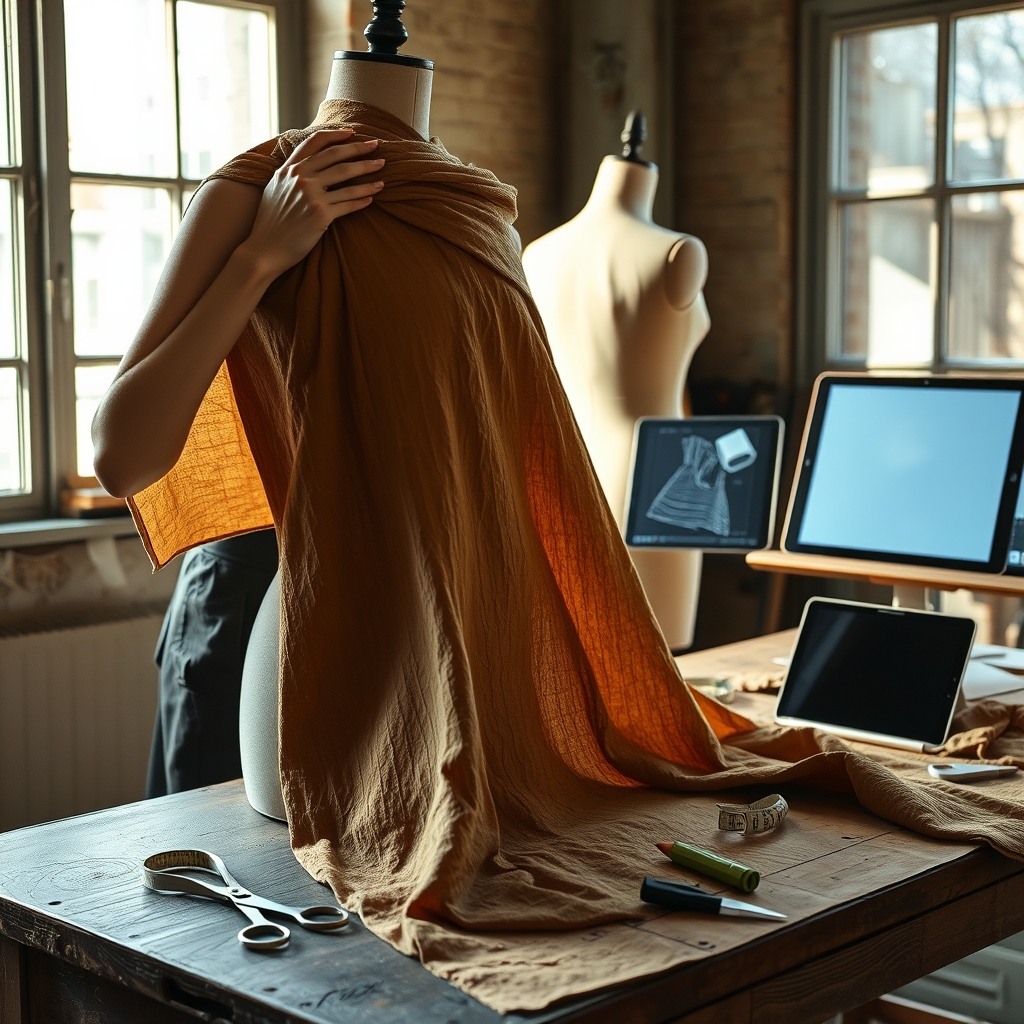
The first time I held a bolt of fabric against the light, I saw not just cloth, but a conversation waiting to unfold. The way it draped, the way it resisted or yielded to the touch—it was as if the material itself was whispering secrets about the body it was destined to embrace. This was before I understood the mathematics of fit, before I learned that every curve, every hollow of the human form could be translated into lines and angles, into a silent algebra that only the most attentive hands could decipher.
The Geometry of Silence
Zero-waste pattern cutting is not merely a technique; it is a philosophy of listening. It demands that we approach fabric not as a canvas to be dominated, but as a collaborator in a delicate dance. The scissors do not cut blindly; they follow the contours of the body’s unspoken needs, tracing the path of least resistance, where waste is not an afterthought but an impossibility. There is something almost sacred in the way the pieces fall into place, as if the fabric itself is guiding the hands that shape it. The body, in all its asymmetry and imperfection, becomes the blueprint, and the pattern emerges like a revelation—each seam a line of dialogue, each dart a punctuation mark in the story of fit.
I remember the first time I drafted a pattern this way, watching as the fabric yielded to the body’s unique topography. There was no excess, no apology for the shape it was meant to clothe. It was as if the garment had always existed, waiting only for the right hands to coax it into being. The process felt less like creation and more like discovery—a quiet unearthing of something that had been there all along, hidden in the folds of the cloth and the curves of the body.
The Anthropometric Whisper
Anthropometry is the science of measurement, but in the hands of a tailor or a designer, it becomes something far more intimate. It is the art of hearing the body’s silent language, of translating its dimensions into a dialogue between cloth and skin. The tape measure is not just a tool; it is an extension of the ear, attuned to the subtle frequencies of the body’s geometry. A quarter-inch here, a half-inch there—these are not mere numbers, but the notes in a symphony of fit, each one resonating with the body’s unique rhythm.
There is a moment, just before the scissors meet the fabric, when everything hangs in balance. The measurements have been taken, the pattern drafted, but the true test lies in the way the garment will settle against the skin. Will it move with the body, or against it? Will it feel like a second skin, or a foreign imposition? This is where the magic of anthropometric design reveals itself—not in the precision of the numbers, but in the way those numbers are interpreted, in the way they are woven into the fabric’s very structure. It is a conversation without words, a dialogue of touch and tension, of give and take.
The Alchemy of Absence
What is left out of a garment is often as important as what is included. Zero-waste pattern cutting teaches us the value of absence—the way a well-placed seam can eliminate the need for darts, the way a strategic fold can replace a pleat. It is a lesson in economy, not just of material, but of intention. Every cut, every stitch, must serve a purpose, must contribute to the garment’s harmony with the body. There is no room for excess, no space for the superfluous. In this way, the process becomes a meditation on what it means to truly fit—not just in the physical sense, but in the way a garment aligns with the wearer’s essence.
I once worked with a client whose body defied every standard sizing chart. She was neither tall nor short, neither slender nor broad, but something in between, a shape that existed outside the rigid categories of mass production. As I took her measurements, I realized that this was not a challenge to be overcome, but an opportunity to listen—to hear the unique song her body was singing and to translate it into cloth. The pattern I drafted was not a compromise, but a celebration of her form, a garment that fit her as if it had been grown, not made. When she tried it on for the first time, the look on her face was one of recognition, as if she had finally found something she hadn’t known she was missing.
The Future Woven in Threads
The intersection of zero-waste pattern cutting and anthropometric design is more than a technical innovation; it is a return to the roots of clothing as a second skin, a protective layer that moves with us, breathes with us, becomes a part of us. It is a rejection of the disposable, the ill-fitting, the mass-produced, in favor of something deeply personal, something that honors the body’s individuality. In a world that often seeks to standardize, to flatten the nuances of human form into a one-size-fits-all mold, this approach is nothing short of revolutionary.
As technology advances, so too does our ability to listen to the body’s whispers. Digital pattern development and 3D garment simulation allow us to refine this dialogue, to test and iterate without ever picking up a pair of scissors. But no matter how sophisticated the tools become, the essence of the process remains the same: it is about hearing, about understanding, about responding. The fabric does not lie; it tells the truth of the body, if only we know how to listen. And in that listening, we find not just the perfect fit, but a deeper connection to the very fabric of being.
The garments we create are more than mere coverings; they are extensions of ourselves, woven from the threads of our measurements, our movements, our silent conversations with the world. To wear them is to be seen, not as we are expected to be, but as we truly are—flawed, beautiful, and utterly unique. And in that seeing, there is a kind of grace, a quiet acknowledgment that the body, in all its complexity, deserves to be clothed not just in fabric, but in understanding.