
The Hushed Cartography of Skin: How Adaptive Clothing and Anthropometric Whispers Are Redrawing the Body’s Silent Map
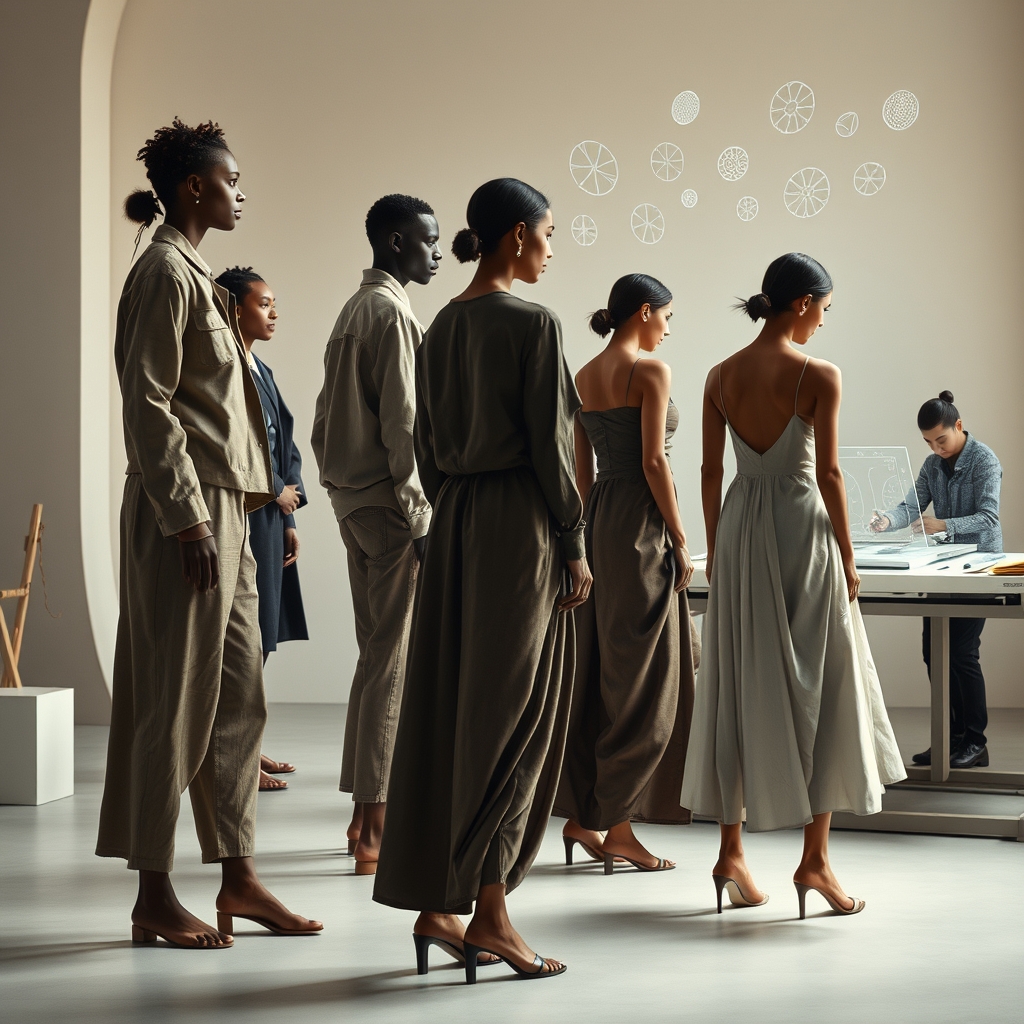
The body has always been a landscape—soft valleys of muscle, ridges of bone, the gentle swell of breath beneath skin. Yet for centuries, we have dressed it in approximations, in garments that fit the idea of a body rather than the body itself. The seams of history are stitched with compromise: waists cinched too tight, shoulders burdened with excess, hems that trip over the unique cadence of a stride. But what if clothing could listen? What if fabric, instead of imposing its will, learned to move with the body’s silent poetry?
The Alchemy of Adaptation
Adaptive clothing is not merely about function; it is about reverence. It is the quiet acknowledgment that the body is not a static form but a living, breathing entity, shifting with time, emotion, and circumstance. Consider the way a sleeve might adjust to the bend of an elbow, or how a waistband could expand with the rise and fall of breath. This is not engineering—it is empathy rendered in thread and textile. Anthropometric design, with its meticulous mapping of measurements and proportions, becomes the cartographer of this intimate terrain, translating the body’s unspoken needs into patterns that adapt, rather than constrain.
In the hands of a skilled designer, adaptive clothing is not a concession to limitation but an invitation to freedom. It is the difference between a garment that fights the body and one that dances with it. The technology behind this—3D garment simulation, precision fit analysis, and modular clothing systems—does not erase the human touch; it amplifies it. A seamstress’s intuition, once confined to the tactile, now extends into the digital, where algorithms and anthropometric data collaborate to draft patterns that honor the body’s asymmetry, its quirks, its quiet insistence on being seen.
The Whisper of Zero-Waste
Yet adaptation is only one half of the equation. The other is sustainability—a word often bandied about like a mantra, but rarely given the depth it deserves. Zero-waste pattern cutting is not just a technique; it is a philosophy. It is the art of listening to the fabric itself, of understanding that every scrap is a story half-told, a potential left unrealized. When a designer approaches a length of cloth with the intention of leaving no trace behind, they are not just minimizing waste; they are engaging in a dialogue with the material, asking it to reveal its secrets, to yield its full potential.
This is where the digital and the analog converge. Digital pattern development allows for precision that scissors and paper cannot match, but it is the human eye—the designer’s ability to see the negative space, to imagine the garment before it exists—that breathes life into the process. The result is clothing that fits not just the body, but the world it inhabits. A zero-waste garment is a promise: that we can dress ourselves without undressing the planet.
The Body as Collaborator
What does it mean to design clothing that is not just worn, but experienced? Interactive clothing design and virtual try-on technology are blurring the boundaries between garment and wearer, turning the act of dressing into a conversation. Imagine a dress that responds to the wearer’s mood, shifting color with the rise and fall of their breath, or a jacket that adjusts its insulation based on the temperature of the skin. These are not fantasies; they are the logical extension of a design philosophy that sees clothing as an extension of the self, rather than a disguise.
This is the future of fit: not a one-size-fits-all approximation, but a dynamic, evolving relationship between body and cloth. Collaborative fashion prototyping takes this a step further, inviting the wearer into the design process. No longer a passive recipient of fashion, the wearer becomes a co-creator, their movements, preferences, and even their imperfections shaping the final garment. The result is clothing that does not just fit the body, but fits the life it leads.
The Unseen Stitches
There is a quiet magic in the way a well-made garment moves with the body, as if it were an extension of the skin itself. This is the promise of adaptive clothing, of anthropometric design, of zero-waste pattern cutting: that we might one day wear our clothes as effortlessly as we wear our breath. The technology behind this—digital pattern development, 3D simulation, precision fit analysis—is not cold or impersonal. It is, in fact, deeply human. It is the culmination of centuries of craftsmanship, now refined by the tools of the modern age, but no less rooted in the desire to create something that fits, that belongs, that listens.
The body has always been a map, but it is one we are only now learning to read. With every stitch, every seam, every carefully drafted pattern, we are redrawing the boundaries of what clothing can be. Not just a covering, not just a statement, but a second skin—one that moves with us, breathes with us, and, in its own silent way, speaks for us. The future of fashion is not in the clothes we wear, but in the conversations they allow us to have with ourselves, with each other, and with the world we share.