The Breathing Canvas: How Tech-Integrated Pattern Making and Anthropometric Design Are Painting the Future of Personal Expression
The fabric of our lives is not merely something we drape over our bodies—it is an extension of our breath, a silent conversation between skin and cloth, a dialogue that has evolved with every stitch, every fold, every revolution of the needle. In the quiet hum of a sewing machine or the precise click of a digital pattern being drafted, there lies a profound intimacy, a meeting point where technology and tradition entwine to redefine what it means to wear our identities.
The Alchemy of Precision: When Data Meets the Human Form
There was a time when the art of tailoring was a sacred ritual, a slow dance between the tailor’s hands and the client’s body, where measurements were taken with reverence and patterns were drafted with the patience of a monk illuminating a manuscript. Today, that ritual has not vanished—it has transformed. Anthropometric design optimization and digital pattern development have turned the human form into a living blueprint, a canvas where data and desire converge. Every curve, every asymmetry, every unique contour of the body is now captured with a precision that borders on the poetic.
Imagine standing before a mirror that is not just a reflective surface but a portal—a space where your body is scanned, analyzed, and translated into a pattern that is as unique as your fingerprint. This is not the cold, impersonal efficiency of mass production; it is the opposite. It is the birth of a garment that is not just made for you but of you, a second skin that moves with the rhythm of your breath, the cadence of your steps, the unspoken language of your posture. The body is no longer forced to conform to the rigid geometries of standardized sizing; instead, the cloth bends, stretches, and flows in harmony with the body’s own symphony.
The Zero-Waste Paradox: Crafting Beauty from Absence
Yet, as we stand on the precipice of this new era of hyper-personalization, there is a quiet tension—a question that lingers in the air like the scent of freshly cut fabric: How do we reconcile the desire for the unique with the urgency of sustainability? The answer, it seems, lies not in abundance but in absence. Zero-waste pattern cutting is not just a technique; it is a philosophy, a meditation on the sacredness of material. Every scrap of fabric is a whisper of potential, a fragment of a story yet to be told. To discard it is to silence that voice before it has a chance to speak.
In the hands of a master, a single bolt of cloth becomes a tapestry of possibility. Darts are not merely functional; they are deliberate, like the pauses in a poem. Seams are not just seams—they are the seams of a narrative, guiding the eye and the hand through the garment’s journey. The result is not just a piece of clothing but a testament to the art of making do, of finding beauty in constraint, of proving that less can indeed be more. It is a rebellion against the wastefulness of an industry that has long treated fabric as disposable, and in its place, it offers a vision of fashion as a closed loop, where every thread is accounted for, every inch of cloth is cherished.
The Digital Loom: Weaving the Future of Collaborative Creation
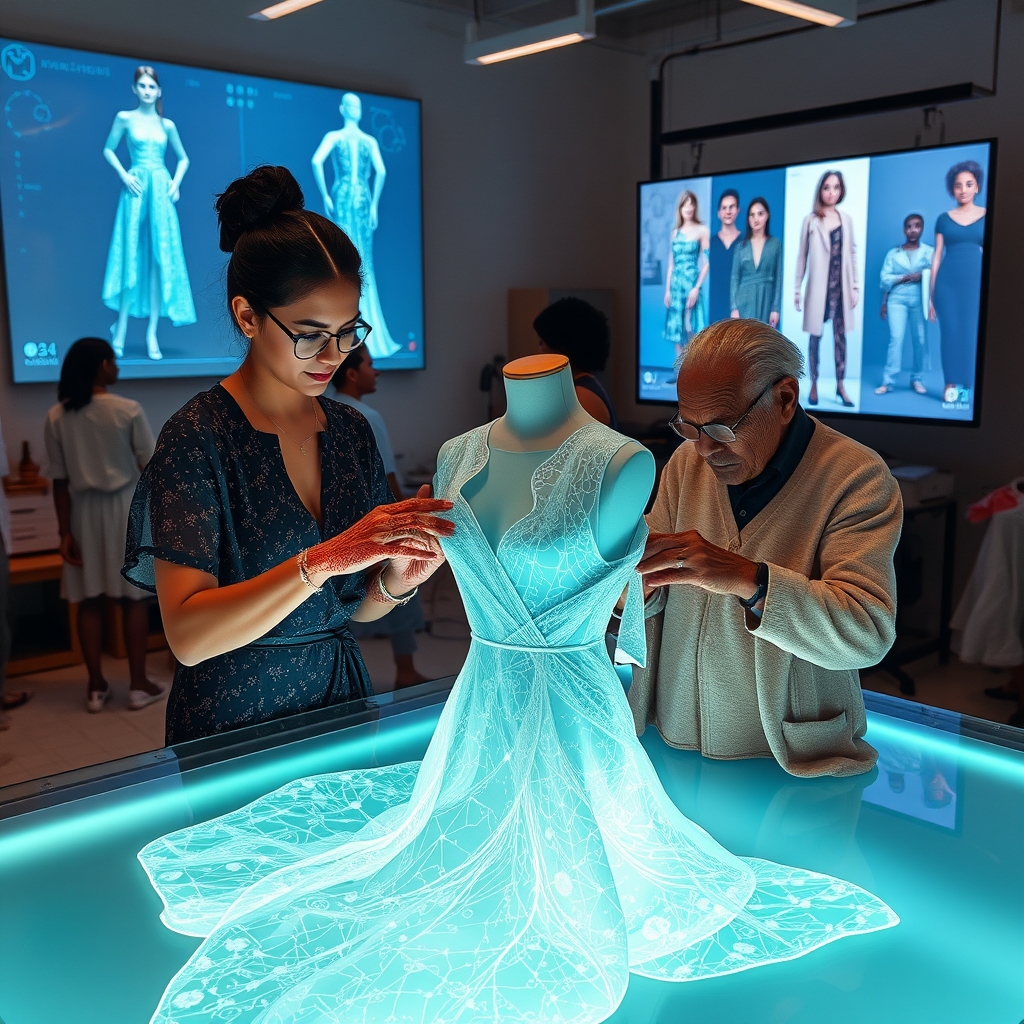
If zero-waste pattern cutting is the poetry of restraint, then collaborative fashion prototyping is the symphony of shared creativity. The digital loom has become a space where designers, engineers, and wearers converge, where ideas are not just exchanged but co-created in real time. Virtual try-on technology and 3D garment simulation have dissolved the boundaries between the atelier and the living room, between the designer’s vision and the wearer’s lived experience. A pattern is no longer a static thing, confined to a sheet of paper or a screen—it is alive, responsive, evolving with every iteration.
This is the future of fashion as a living, breathing entity, one that grows and adapts alongside the people who wear it. Modular clothing systems allow garments to transform, to be reconfigured, to tell new stories with each wear. A dress becomes a top, a skirt becomes a scarf, and in this fluidity, there is freedom—the freedom to express, to adapt, to reinvent. The garment is no longer a fixed statement but a conversation, one that invites the wearer to participate, to shape, to make it their own. It is a collaboration between creator and consumer, between the hands that make and the body that moves.
The Fabric of Tomorrow: Where Ethics and Aesthetics Embrace
At the heart of this evolution lies a fundamental shift in how we perceive the relationship between clothing and the self. It is no longer enough for a garment to be beautiful; it must also be ethical, sustainable, and deeply personal. The fabrics we choose are no longer just a matter of texture or color—they are a statement of values. Organic cotton, recycled polyester, lab-grown textiles—each carries with it a story of responsibility, a commitment to a future where fashion does not come at the expense of the planet or its people.
But perhaps the most radical transformation is not in the materials or the methods but in the mindset. We are learning to see clothing not as a fleeting indulgence but as an investment in the self, in the environment, in the future. A garment is no longer just something we wear; it is something we live with, something that carries the weight of our choices, the echo of our values. It is a silent witness to our journey, a companion in our daily rituals, a reflection of who we are and who we aspire to be.
The act of dressing becomes an act of intention, a daily ritual of connection—to ourselves, to our communities, to the earth. In this new paradigm, fashion is not about trends or seasons; it is about timelessness, about creating pieces that transcend the ephemeral and become a part of our personal mythology. It is about recognizing that every stitch is a choice, every seam a decision, and every garment a small but significant step toward a more thoughtful, more compassionate world. The future of fashion is not just about what we wear—it is about how we choose to live, how we honor the materials that clothe us, and how we weave our stories into the very fabric of our existence.